AQVA — following the water through a Roman aqueduct
An interactive 3D study makes the route from source to distribution visible through guided views and an openable channel.
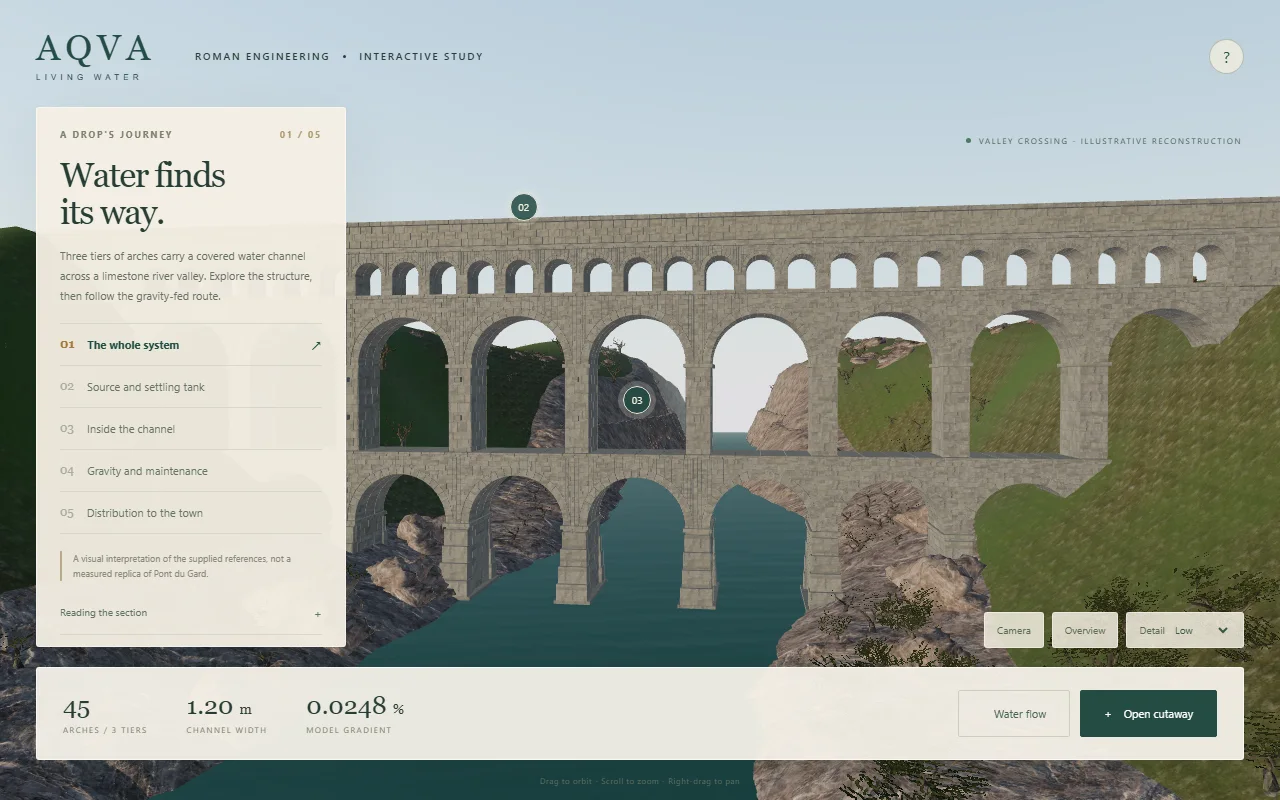
Screenshot of the published AQVA browser demo (V29).
A row of arches is only part of the story. AQVA — Living Water follows a water route across a modelled valley, from an upstream settling tank to a distribution basin. Five chapters connect the overview with closer views of the channel, maintenance openings and outgoing pipes.
A route you can explore
Choose a chapter to move the camera, or orbit the scene yourself. The cutaway reveals the channel behind the masonry. Flow markers can be switched on and off, and Overview returns to the opening view. A quality selector offers a practical way to adjust rendering on your device.
Materials that explain the model
Pale masonry, red-finished channel walls and a separate light floor distinguish the structural and interior surfaces. The distribution view removes service covers so the modelled pipe openings are easier to inspect. These views explain the construction choices in this scene; they are not records of a surveyed monument.
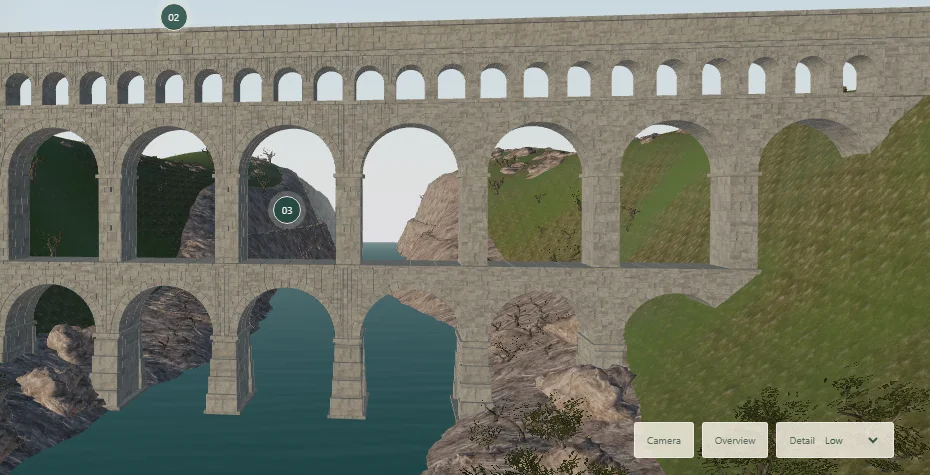
Screenshot of the published AQVA browser demo (V29).
An illustration, with explicit limits
The scene combines selected references into an educational reconstruction. It is not an exact replica of Pont du Gard or a hydraulic or structural simulation. The shortened approaches, three outlet branches and visible section cuts are modelling choices. Animated markers communicate direction; they do not measure flow speed or capacity.
Built for exploration
The demo uses Three.js and a locally bundled GLB model. Chapter buttons provide an alternative to free camera movement, and the interface includes reduced-motion handling and help. The standalone interface is in English; this article is available in all six IOM website languages. Performance depends on the device, browser and selected quality.